Premiere Performance to be announced soon!
She’s Speaking!
for Narrator/Mezzo Soprano, Clarinet & Electronics (2026)
Featuring the poetry of Emily Dickinson, Gertrude Stein, Gwendolyn Brooks* and Marilyn Chin*
*with permission
A portion of She’s Speaking! was performed as part of an Electronic Music workshop offered to the Queens, NY community of Ridgewood in May, 2026.
This event was made possible with public funds from the Queens Art Fund. Awarded 2026
PERFORMANCES
9/2026 Puffin Foundation Grant
4/2026 Queens Art Fund
AWARDS
A community event and workshop feature a performance plus an electronic music workshop for teens in Queens, NY. 5/2026
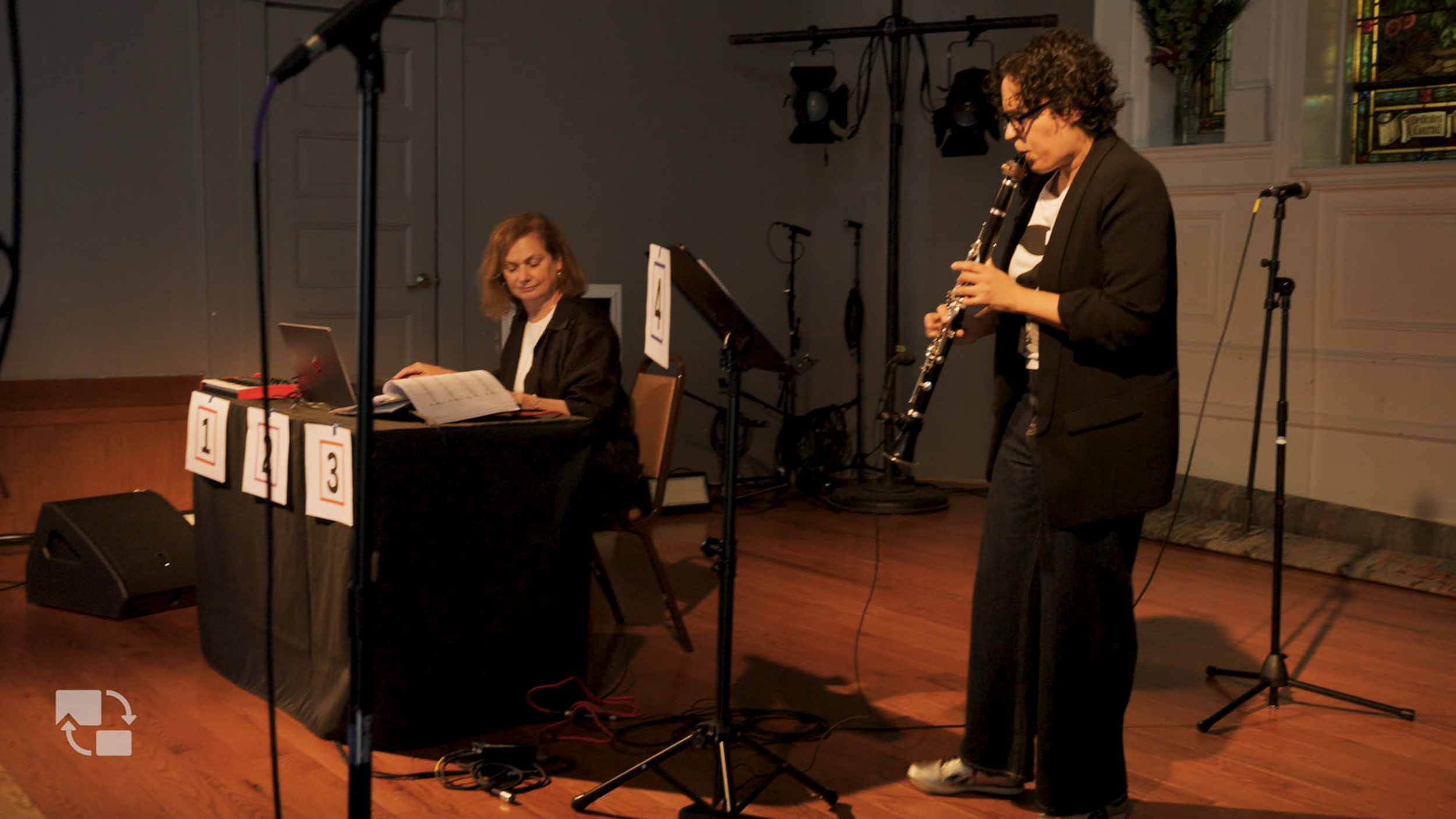
She’s Speaking! is an immersive performance for clarinet and interactive media that reanimates archival recordings of women’s voices to explore the long struggle for women to be heard. Clarinetist Medina’s virtuosity merges with Ellen Fishman’s real-time interactive software to create a spatialized sound world where past and present collide. The piece incorporates recordings from the Library of Congress and poems by Emily Dickinson, Gertrude Stein, Gwendolyn Brooks (permission granted) and Marilyn Chin (permission granted). She’s Speaking! offers a counter-narrative to centuries of silenced perspectives and invites audiences into an embodied listening experience.
DESCRIPTION
I can’t say that any specific event sparked my interest in creating a piece that would explore how women’s voices are ignored, belittled, or simply not heard. I think all women have felt the sting of being disregarded in one way or another. However, when contemplating a partnership with Medina, I had a conversation with a former student who told me how, in the corporate world, her ideas are often taken up by men and made actionable in the very same meeting. Nothing can take away the sting of these encounters, which often leave us feeling alone with our potential unrealized in an unfair dynamic that has been so well documented by women poets and writers. When thinking of my student in this situation, I got angry, knowing her brilliance and how she would work harder with no promise of a different result. I was also angry that this dynamic has really not gotten better in my lifetime. This short essay is an attempt to help you understand my own evolution through this project.
I have done many pieces that feature poetry, either spoken, sung, or projected in video. Most of this work was with poet Michael Heller. However, this is my first work combining poetry with live interaction and spatial audio. The addition of electronics allows me to immerse the audience in the sound, with speakers surrounding them. This allows me to work with the materials in new and exciting ways. For example, as I read more and more poetry by women, I heard a singular voice emerge from the shared experience of how we are perceived in the world, and from the great understanding and learned patience that women have to develop in order to exist. It is this singular voice I am thinking of in the crowd of women’s voices heard at the beginning and end of the work. It is very symbolic to me that the singular voices grow out of the multitude of women’s voices that engulf the listener with each swell in the clarinet. The sound sources for the singular voices were downloaded from Wikimedia Commons or from the Library of Congress, mostly using the Citizen DJ site.
I began by reading Gertrude Stein, which I credit to my sister Esther (also a poet). She has spent a lot of time with Stein’s work and felt her place in history needed to be amplified in my piece. (Thanks, Est!) Her live recordings, recorded in 1935 at Columbia University, demonstrate what a performer she was, with impeccable readings of rhythmically intricate poems. The confidence in her voice brings to life a time when the art world gathered in her living room to listen to her, if only for one evening. I was a little perplexed about how to set her voice with the clarinet, and charted her word devices, but realized that her breath provided the structure from which to build the clarinet accompaniment. Medina learned to navigate from Stein’s voice by following the phrases of the poem. The performance of the poetry was surprisingly metric, which also helped me when setting the poem.
When I searched for poets influenced by Gertrude Stein, I was led to the poetry of Harryette Mullen. In “Trimmings,” she brilliantly weaves wonderfully rhythmic poems that touch on the theme with clever descriptions of the delicate balance between our sense of self, our sexuality, and our independence. Unfortunately, I did not have any luck getting a response from her publisher, and it is for this reason that I switched out a “perfect” Harryette Mullen poem at the beginning for another perfect poem by Emily Dickinson. This decision led me to think of the progression of poems as chronological, starting with Dickinson. While some may interpret “I took my Power in my Hand” (1862–1863) as simply a David vs. Goliath poem, I feel it takes on a different meaning when written by a woman. Feeling small and smallness will be a theme picked up later in the poem by Marilyn Chin.
I realized that much of what I was finding was giving voice to feelings I had experienced my whole life. It got especially personal to me when I read Gwendolyn Brooks’ “my dreams, my works, must wait till after hell” (1963). While I wouldn’t describe having a family, teaching full time, and writing music in every second of free time as being in hell, it certainly kept me in a constant cycle of self-loathing, since the amount of writing time I had was never enough. I knew during that period of time I was storing my ideas and aspirations “in little jars and cabinets of my will.” Some poems are presents, and this one I will cherish for life.
How to end a work such as this that really has no ending? The discovery of Marilyn Chin’s bold “From ‘The Girl Box Series’” (2012) provided the swagger I wanted to end with. In this part of our history, we are mad, resilient, proud, and do the best we can with what we are dealt. After reading Marilyn’s poem, I immediately thought of it as a song. It was then that I made the decision to have a live narrator who could also sing, which brings more drama to the whole work.
I barely scratched the surface of the theme with this 15-minute work. One thing I do know is that we have a lot of brilliant women poets in our world! Perhaps this is just the beginning of a much larger work?
After months of listening and reading with the specific goal of discovering what women have said about the value and power of their spoken words, I come away feeling strengthened by the multitude of their voices. It was not easy finding recordings of women before 1960, especially recordings by women of color. However, with each discovery, I felt less alone in our struggle and proud of those women who spoke up. I hope that by gathering this small collection of women’s voices, you may also gather strength from the wisdom of women across generations.